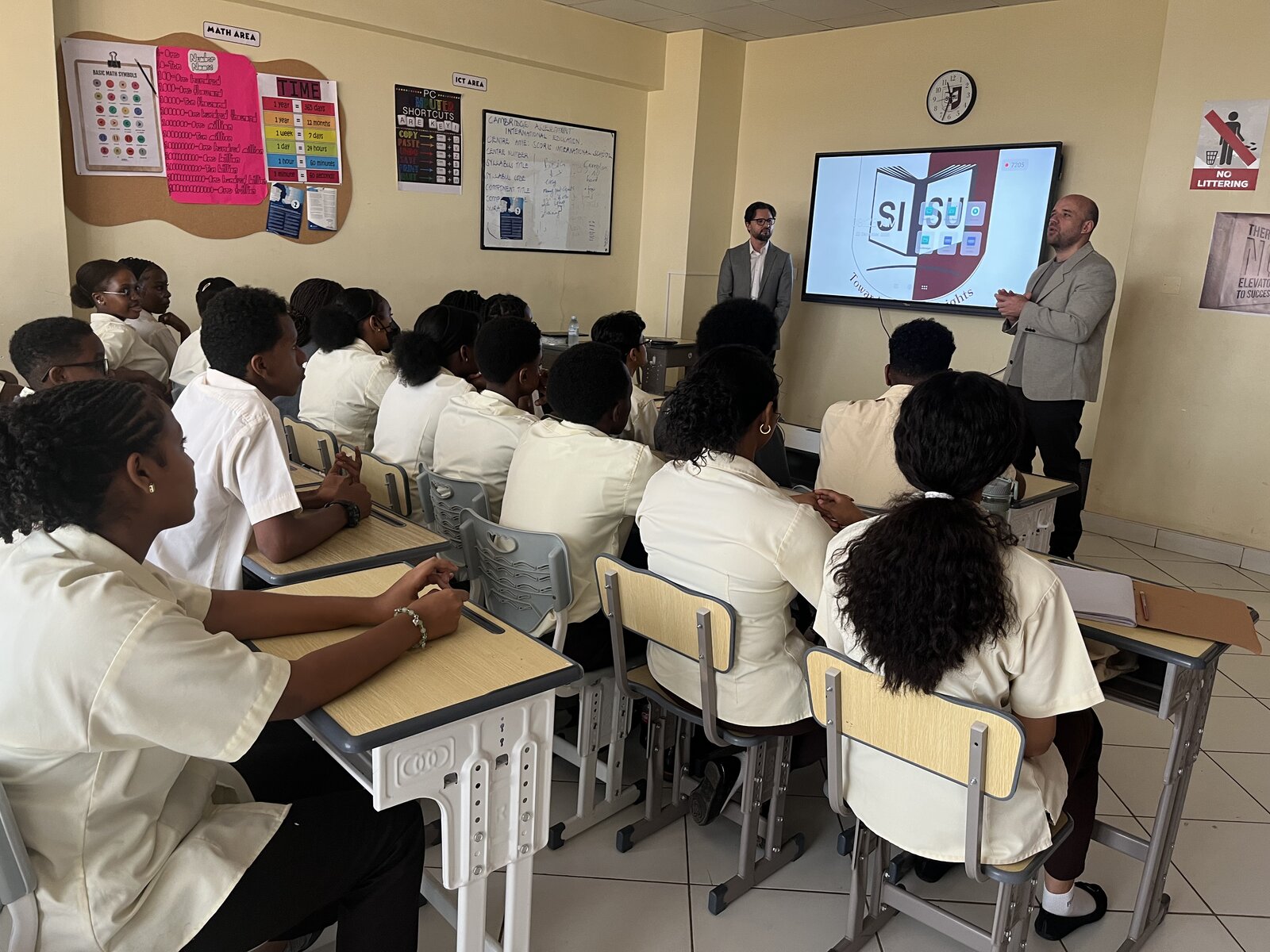
Scoris International School Uganda
Strategic foundations for a new international school
2 priorities
Focused path from ambition to execution
A newly established Cambridge-curriculum school in Kampala wants to become the leading international school in Uganda. The intent was clear. The path was not. This case study describes the diagnostic and strategy work in progress, and why clarifying priorities early matters more than moving fast.
At a glance
- Location
- Kampala, Uganda
- School type
- Privately owned international school
- Current curriculum
- Cambridge CAIE (IGCSE, AS/A Level)
- Age range
- 12 to 19
- Community
- 10+ nationalities
- Registration
- Uganda Ministry of Education
- Strategic priority
- IB authorization preparation
- Engagement status
- Active, ongoing
A note on this case study: Scoris is an active Nordic Education Academy engagement. The full strategic plan is confidential to the school. What follows describes the diagnostic approach, what we found across stakeholder groups, and the shape of the priorities agreed with the board, enough to show the methodology without publishing the client's roadmap. We will update this case study as the engagement progresses and outcomes emerge.
Section
The starting point
The Scoris board has a clear ambition: to be the first and best international school in Uganda. That ambition is the precondition for everything else. Without it, no strategy matters. But ambition alone is never enough.
When we began the engagement, the school had many of the right ingredients in place: capable teachers, a committed board, good processes in several areas, and an active community of parents and students. What it lacked was a clear, sequenced path from where it stood today to the position the board wanted it to hold.
This is not a criticism of Scoris. It is the normal condition of almost every new international school. The question is how a school moves from "we want to be excellent" to "here are the three things we are working on this year to get there." That translation is what leadership research calls focus, and it is one of the harder capabilities to build.
Section
The diagnostic: four voices, not one
We structured the diagnostic around the four stakeholder groups who experience the school differently and who, together, reveal the full picture that no single group can see alone.
Students
We asked students to describe the strengths of the school in their own words and to walk us through their daily schedule as they actually experience it. What students value and what the school thinks it offers are not always the same thing. Closing that gap is a source of competitive advantage.
Parents
We explored how parents understood international education and how they experienced the school relative to that understanding. Parents of current students are the school's primary reputation channel. Their lived experience shapes word-of-mouth growth, or constrains it.
Teachers
We worked with teachers on inquiry-based teaching practice and on pulling learners into the learning process rather than delivering content to them. This is the pedagogical shift that matters most as the school prepares for IB authorization, and the one that cannot be rushed.
Board and leadership
We mapped the strategic ambition against current capability honestly. The gap is the work. Making that gap visible, without blame, is the foundation of any strategy a board and leadership team can actually execute together.
Section
What the diagnostic surfaced
Scoris had more working in its favour than it realised. Processes were in place in several important areas. Teachers were genuinely passionate. The board's ambition was real.
What was missing was not raw capability, it was a shared, prioritised path that connected current strengths to future outcomes. Strategy, in other words, not effort.
Section
The priorities agreed with the board
From the diagnostic, we worked with the board and leadership team to agree two immediate priorities. Focused priorities, not a long list of improvements.
Priority 1: Student wellbeing follow-up
Establishing structured processes that ensure every student is known, checked in on, and supported. Not ad hoc or personality-dependent, but institutionally consistent.
Priority 2: Tracking of progress
Building the assessment and progress-monitoring infrastructure that lets the school see how students are developing over time, and intervene early when they are not.
Why only two priorities
New schools often receive strategies with fifteen recommendations. Nothing gets done because everything is urgent. Two priorities, executed well over a school year, produce more change than fifteen priorities attempted in parallel. Strategic discipline is a leadership capability, and it is rare.
Section
How this maps to leadership research
Robinson (2008) identified ensuring quality teaching and leading teacher learning and development as the two leadership dimensions with the highest effect on student outcomes. Priority 1 (wellbeing follow-up) and Priority 2 (progress tracking) are not tangential to academics, they are the infrastructure through which academic teaching becomes effective. A teacher cannot teach a student they do not know is struggling.
Marzano's (2005) monitoring and evaluating responsibility (r = 0.27) and discipline responsibility (r = 0.27) map directly onto these two priorities. Schools that measure learning effectively and protect teachers from distraction consistently outperform those that don't, regardless of curriculum, region, or budget.
And at the strategic level, Marzano's focus responsibility (r = 0.24) is the one the Scoris board itself is now practising. Narrowing from everything-matters to these-two-matter-most is the hardest move for an ambitious institution to make. It is also the most important.
Section
What this case shows other newly established schools
You cannot fake experience a school does not yet have. But you can build the infrastructure, wellbeing processes, progress tracking, shared strategic priorities, that predicts strong outcomes when the first cohorts are ready.
The schools that rise fastest in their markets are the ones that invest in these foundations before they are visible, not after. And strategic discipline, the willingness to work on two things well rather than fifteen things badly, is itself a competitive advantage.
Sources
Scoris International School Uganda public website (scorisinternational.ac.ug, scorisinternationalschool.ug); LinkedIn (Scoris International School Uganda); diagnostic engagement notes from Nordic Education Academy's strategic work with Scoris. The detailed strategic plan is confidential to the client.
Published 2026-04-20 · Updated 2026-04-20
A version of this story could be yours.
We work with one school at a time per advisor. If you're considering an engagement, the conversation starts here.
Get in touchMore from Client Engagements