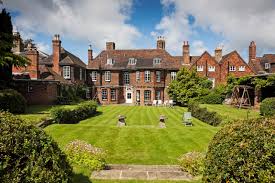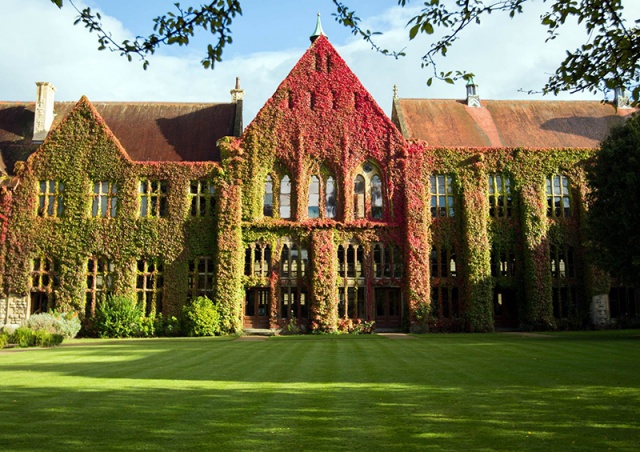
Cheltenham Ladies' College
Tradition as a platform for innovation
39.3
IB average 2024 (world: 30.3)
A 170-year-old girls' boarding school with IB Diploma averages consistently 8 to 10 points above the world average offers a distinctive model for school leadership: academic excellence driven through values continuity, holistic wellbeing, and a long-tenured principal who questions inherited practice.
At a glance
- Location
- Gloucestershire, United Kingdom
- School type
- Girls' boarding school, ages 11 to 18
- IB Diploma since
- 2008
- IB average 2024
- 39.3 points (world average: 30.3)
- Peak IB average
- 42.7 points (2021 cohort)
- Principal
- Eve Jardine-Young (Executive Principal since 2011)
- Students from
- 40+ countries
This is an independent analysis of publicly available information, interpreted through research undertaken at UCL and leadership practice in leading European IB schools. Cheltenham Ladies' College is not a Nordic Education Academy client, and this analysis does not imply any relationship or endorsement.
Section
The leadership approach: strategic clarity through structural separation
Cheltenham Ladies' College (CLC) runs a dual-principal model that is unusual in UK independent schools. An Executive Principal focuses on strategy, partnerships and long-term direction. A Head of College is responsible for the day-to-day running of the school. This separation allows the principal to do the work that educational leadership research suggests matters most, setting direction, shaping culture, and driving change, without being absorbed into daily operations.
Eve Jardine-Young's background is also atypical for the head of a traditional girls' school. She studied Engineering Science at Cambridge and worked in industry before entering education. Her published writing covers leadership, careers of the future, holistic education and staff professional development. She chaired the World Leading Schools Association for five years.
Section
Four leadership characteristics visible in the public record
1. Change agency. In 2015 she publicly advocated abolishing homework in response to student stress levels, challenging one of the most entrenched assumptions in UK education.
2. Ideals and beliefs. She frames tradition as a source of courage and belonging rather than constraint, and draws explicit lines from the school's founder in 1853 to present-day values decisions.
3. Outreach. Active international conference presence in Hong Kong, Washington, and Prague, speaking on leadership, wellbeing, and the fourth industrial revolution.
4. Focus on the whole pupil. "Academic excellence at College concerns much more than exam grades" is not marketing language, it shapes how the school reports results, alongside personal development outcomes.
Section
How this maps to leadership research
Marzano and colleagues (2005) identify situational awareness (r = 0.33), flexibility (r = 0.28), and change agency (r = 0.25) as three of the highest-correlation leadership responsibilities in their meta-analysis of 69 studies covering more than 2,800 schools. Jardine-Young's approach, pairing deep knowledge of the institution's history with willingness to dismantle inherited practices when the evidence demands it, demonstrates all three simultaneously.
Robinson (2008) found that leading teacher learning and development produces the largest effect size (0.84) of any leadership dimension on student outcomes. CLC's investment in teacher CPD frameworks and the principal's active writing on professional development fits this pattern directly.
Section
What Nordic and international IB leaders can take from this
Long principal tenure allows cultural change to compound over time. A dual-principal structure frees strategic leadership from operational drag. And values rooted in institutional history, when actively chosen rather than passively inherited, can become the most durable driver of academic excellence.
The CLC model is not directly transplantable to every school. But the mechanisms, strategic focus protected from operational noise, explicit cultural stewardship, and willingness to question the school's own traditions, can be built anywhere.
“A place where we welcome girls with the potential and appetite to try, to be responsive, to be challenged, not to just be leaders, but to be capable of leadership, to understand the relational choreography that is not just all about 'me', but also about followership and allyship.”
Sources
Cheltenham Ladies' College published IB results 2019 to 2025; CLC principal biography; Japan Times interview (2024); Independent Schools Show speaker profile. All quotes drawn from published interviews and public statements.
Published 2026-04-20 · Updated 2026-04-20
A version of this story could be yours.
We work with one school at a time per advisor. If you're considering an engagement, the conversation starts here.
Get in touch