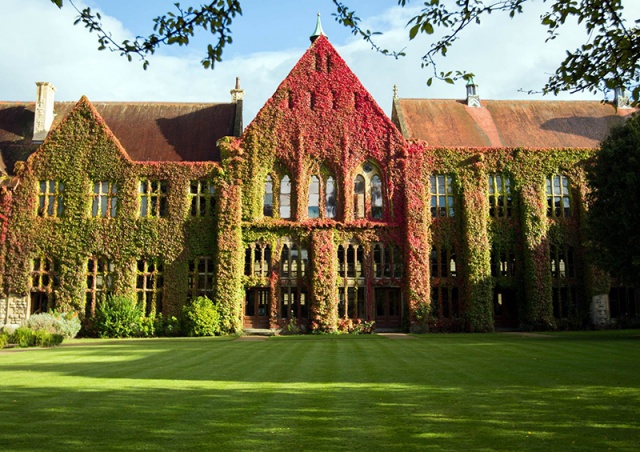
Sevenoaks School
Full IB commitment at scale
39.4
IB average 2025 · 245 candidates
Co-educational, 100% IB, and one of the largest IB Diploma cohorts in the world, Sevenoaks has operated without A Levels since 1999. Its consistent performance at scale reveals a different model for school leadership: research-embedded practice, institutional commitment to a single academic pathway, and distributed pedagogical ownership.
At a glance
- Location
- Kent, United Kingdom
- School type
- Co-educational day and boarding, ages 11 to 18
- Founded
- 1432
- IB Diploma since
- 1978 (exclusively since 1999)
- Cohort size
- 245 IB Diploma candidates (2025)
- IB average 2025
- 39.4 points (world average: ~30)
- 40+ point achievers
- More than half the cohort, consistently
- Headmaster
- Jesse Elzinga (since 2019)
This is an independent analysis of publicly available information, interpreted through research undertaken at UCL and leadership practice in leading European IB schools. Sevenoaks School is not a Nordic Education Academy client, and this analysis does not imply any relationship or endorsement.
Section
The leadership approach: clarity through singular commitment
Sevenoaks is, in scale, closer to a university college than a traditional independent school. With all Sixth Form students taking the IB Diploma and a single-pathway commitment since 1999, the school has built its leadership infrastructure around pedagogical depth rather than programme comparison. There is no internal debate about whether A Levels or IB are preferable. That institutional clarity removes a significant source of strategic drift that affects most dual-track schools.
The current Headmaster, Jesse Elzinga, is a Rhodes Scholar with an Oxford postgraduate degree in ethical philosophy. He arrived in 2019 from a previous headship, bringing cross-sector leadership experience from Harvard, international education, and multiple headships.
Section
The Institute of Teaching and Learning: research as infrastructure
Sevenoaks runs an internal Institute of Teaching and Learning (ITL), a research function embedded within the school itself. Its mandate is explicit: to bridge the gap between academic research and classroom practice, publish an annual journal (Innovate), run CPD, and host a biennial conference. Teachers are invited into research fellowships. The ITL is a mechanism for institutional learning, which is rare in secondary education.
Section
Five leadership characteristics visible in the public record
1. Intellectual stimulation. The ITL actively disseminates current educational research to staff. Teachers are expected to engage with it, not merely receive it.
2. Resources. Significant institutional investment in research fellowships, CPD infrastructure, and publication channels.
3. Focus. Single-pathway commitment since 1999 eliminates the resource-splitting that plagues dual-track schools.
4. Outreach. The school opts out of league tables by policy, publishes results transparently, and builds partnerships with schools in Morocco, South Africa, Bali and Ukraine.
5. Culture of global citizenship. International service learning is structural, not decorative. The 2025 ISI inspection rated teaching and learning "exceptional".
Section
An honest note on scale and selectivity
Sevenoaks is highly academically selective, roughly four applicants per Sixth Form place. High entry standards contribute substantially to strong output. The leadership model operates on pre-selected ability, so its specific practices are not directly transplantable to non-selective contexts. The mechanisms, institutional research, focused commitment, distributed pedagogical ownership, are.
Section
How this maps to leadership research
Robinson's (2008) finding that leading teacher learning and development is the highest-impact leadership dimension (effect size 0.84) is institutionally operationalised at Sevenoaks through the ITL. Few schools convert this research finding into standing infrastructure. Most treat CPD as an annual calendar event; Sevenoaks treats it as a research function.
Leithwood and colleagues (2004) identify "developing people" as one of four core leadership functions. When that function is delegated to a dedicated internal institute with research fellows, a journal, and a conference, the leadership team gains capacity to work on the other three, setting direction, redesigning the organisation, and managing the instructional programme.
Section
What Nordic and international IB leaders can take from this
Institutional commitment to the IB Diploma, rather than running it alongside a national curriculum, removes strategic ambiguity and concentrates resources. A research function inside the school, however small, changes how professional development operates: it becomes continuous, evidence-based, and owned by teachers themselves. Neither requires Sevenoaks' scale to begin.
“The Institute of Teaching and Learning bridges the gap between academic research and classroom practice, making research findings more readily accessible to classroom teachers and allowing us to conduct our own research projects too.”
Sources
Sevenoaks School published exam results 2023 to 2025; Sevenoaks School ITL overview; ISI inspection report September 2025; WhichSchoolAdvisor review; Good Schools Guide; Absolutely Education interview with the Headmaster; Wikipedia. All quotes drawn from published school materials and interviews.
Published 2026-04-20 · Updated 2026-04-20
A version of this story could be yours.
We work with one school at a time per advisor. If you're considering an engagement, the conversation starts here.
Get in touch